Blog
Thoughts, updates, and practical deep-dives into modern software development and digital innovation. We share insights on high-performance architecture, web standards, and the technical decisions behind building scalable, resilient technology.
Note: We migrated our blog posts from an internal wiki in Summer 2026; publish dates reflect the migration, while the revision history reflects actual edits.
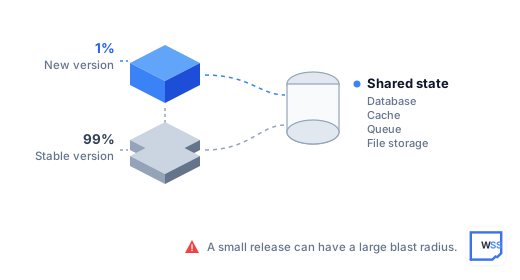
Canary Deployments: Why Shared State Can Turn a 1% Release Into a 100% Outage
Canary deployments reduce the blast radius of stateless bugs, but shared databases, queues, and caches can still cause fleet-wide outages. Learn the failure modes and how to protect against them.
DevOpsReliability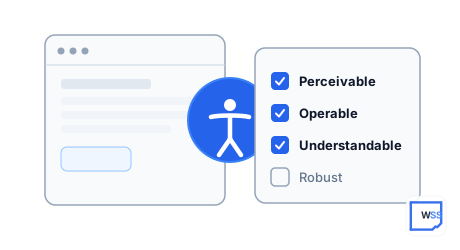
WCAG 2.2 AA Testing: How to Test the 6 Criteria Automated Scanners Miss
Why automated scanners miss new WCAG 2.2 AA criteria, and how to test all six in practice: sticky header focus clearance, dragging fallbacks, 24px target spacing, and authentication.
AccessibilityWCAG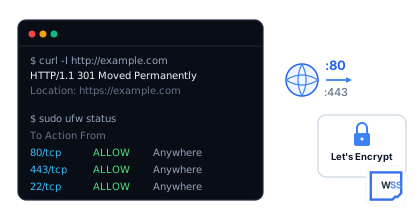
Why Port 80 Is Required for ACME HTTP-01 Renewals: Troubleshooting AWS Ingress and Port 443 Failures
A production debugging runbook for diagnosing ACME HTTP-01 validation drops, intermediate certificate breaks, ALB redirect loops, and NLB protocol mismatches on AWS.
SecurityDevOps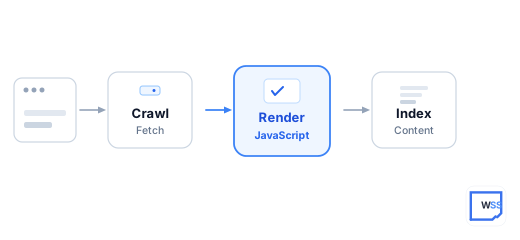
How Googlebot Renders JavaScript and How to Diagnose When It Fails
Is JavaScript stopping Google from indexing your website? Learn how to test if Google can see your content, find out what is broken, and learn the easiest way to fix it.
SEOJavaScript
What Is llms.txt? How It Works, What It Does, and Whether You Need It
An explanation of the llms.txt proposal, what it defines, what it leaves to AI consumers, and how to decide whether to implement it.
AEOArchitecture
Why Is the Web Still Built on Text?
Why the web still relies on text, from CPU cache physics to the V8 JIT pipeline, LayoutNG fragment trees, and WebAssembly security boundaries.
ArchitectureFundamentals
Accessible Name Computation: Why axe and Screen Readers Can Appear to Disagree
Why axe-core can flag an accessible-name problem even when a screen reader appears to announce the control correctly, with practical examples of AccName, ARIA, and native HTML semantics.
AccessibilityTesting
Buildless Architecture: Import Maps and modulepreload in Production
How to deploy production-ready JavaScript without a bundler using native ES modules, import maps, and modulepreload.
ArchitecturePerformance
Document Picture-in-Picture: Breaking Out of the Browser Tab
Render arbitrary HTML, Canvas, and React components in an always-on-top Picture-in-Picture window.
APIsArchitecture
Multi-Tab Synchronization: Consolidating Redundant WebSockets
Use BroadcastChannel and SharedWorker to multiplex multiple tabs through a single WebSocket connection and reduce backend load.
ArchitecturePerformance
Speculation Rules API: Zero-Latency Navigation Without an SPA Router
The Speculation Rules API lets an MPA prerender the next page before the click, without the bundle cost or hydration overhead of a client-side router.
ArchitecturePerformance
CompressionStream API: Replace pako and zlib.js with Native GZIP
Replace heavy JavaScript compression libraries with the browser's native CompressionStream API to compress data payloads directly on the client.
PerformanceAPIs